Showing posts with label death. Show all posts

Wednesday, 25 July 2012

Is Christianity A Crutch? Part Four - Not Exactly Rocket Science

Well, here we are, still looking at crutches. We have been looking at crutches for a while now. This is Crutch Post Number Four, and I'm happy to say that this will be our last look at crutches. Next post we will look at something else. Something that isn't crutches. Maybe something that is non-weight-bearing entirely. I'm not sure what yet. It might be the Top Ten List Of Movies Where Someone Has To Talk Someone Else Into Returning To Somewhere That They Alone Have Escaped From Because They Alone Escaped From It And Can Therefore Act As A Guide For The People Who Now Need To Go There. Though that depends a bit on whether I can a) Find a more concise title and b) Find another seven films where someone has to talk someone else into returning to somewhere that they alone have escaped from because they alone escaped from it and can therefore act as a guide for the people who now need to go there.

But for now, let us push on through to the end of our crutchy series. In case you have not been following along, here is the question that prompted the crutch quadrilogy:

Is Christianity Just A Crutch For The Weak?

Is Tiny Tim's crutch just a crutch? Maybe. But does he need it?
Well, no, apparently, but that's because he's got a Kermit too.

In Part One we said that the answer is basically "Yes, but you are asking the wrong question". The right questions are: Do we need it? Does it work?
In Part Two we said "Yes, you need it". Because everyone needs it. Because we all face death, and we all face judgement.
In Part Three we said "Yes, it works". Because those who are "in Christ" will be rescued from death and rescued from judgement.

So here we are in Part Four. And if you agreed with parts one to three, then the question on your lips should now be: How do we get it? If we need this crutch, and it actually works, where do we have to sign to get ours delivered?

Having this crutch, as we saw in part three, means being "in Christ". Or "belonging to Christ". So how do we get to be "in Christ"? What does that even mean? How do we get to be in the club? Do we have to be especially nice? Do we have to renounce the evils of alcohol, dress in white robes, grow a beard, buy rainbow straps for our guitars, start helping old ladies across the road? Do we have to earn our way into Christ's good books by giving money to charity, singing Gregorian chants before breakfast every day, rescuing orphaned hedgehogs and building trampolines for underprivileged squirrels?

Aaaaaaaaaaaaaaaaaaaaaaaaaaaaaaaaaaaaaaaaaahhhhhhh!

This, I think, is the commonly held view of Christianity - both outside and, sadly, inside the church. Okay, maybe not the squirrel trampoline bit, but something like this: Do Nice Things To Get On God's Good Side. Or worse, Stop Doing Fun Things So As To Avoid Getting Smit*.

Just like the whole "works for some people and not for others" view of Christianity we debunked in the last post, it's hokum, bunkum, balderdash and tosh.

Let me try to explain what being "in Christ" really means, via my slightly tortured Royal College of Music analogy.**

At the Royal College of Music, I studied the violin with Professor Dona Lee Croft. Dona Lee is lovely. She rescues stray foxes. (I know this for a fact, because I met them.) She's the kind of person who probably would build trampolines for underprivileged squirrels, if she thought it would help. And she's a great teacher. Her pupils love her. Being her pupil is a Smashing Thing.

How did I become Dona Lee's pupil?

Well, it's an incredible story... but it went something like this. Ready for this?

Me: Hi Dona Lee, please would you be my teacher?
Dona Lee: Hmmmmm... why, yes dear, okay.

Not exactly rocket science.

You see, I didn't become her pupil by dazzling her with my amazing violinistic ability - in fact, I started going to her for lessons shortly after failing my end of year recital exam. There was no way I could have impressed her with my playing.
No, I became her pupil by asking, and being her pupil meant listening to her, trusting her, and trying to obey her - which made me more like her (a good violinist). The crucial point here is to distinguish correctly between cause and effect: being her pupil made me good. Being good didn't make me her pupil.

Now, Dona Lee is not the Messiah, lovely as she is***. But that white-knuckle thrill-ride adventure story of how I became her pupil is a reasonably good analogy for how we get to be in Christ.

So we don't become Christ's by dazzling him with our amazing goodness - in fact, as we know from part two, if there was an end of year exam in being "good", we'd all fail it. There is no way we can impress God with our "goodness".
No, we become Christ's by asking, and belonging to Christ means listening to him, trusting him, and trying to obey him - which should make us more like him. The crucial point here is to distinguish correctly between cause and effect: being Christian should make us good. Being good doesn't make us Christian.****

So. Let's stick the whole shebang in a nutshell:
Christianity.
Is it a crutch? Yes.
Do we need it? Yes. Everyone does. Even nice people.
Does it work? Yes.
How do we get it? By asking for it.

"Do I still get my trampoline? Do I? Do I?"

So there you go. That's the end of this series. If, by any chance, you made it through all four of these posts, please think carefully about what to do next. You could do a lot worse than hunting out a Christianity Explored course, where you'll be able to consider all this in more detail. Albeit with fewer random pictures. Or get in touch here with any questions.

At any rate, do come back again for my top ten list of films where someone has to talk someone else into returning to somewhere that they alone have escaped from because they alone escaped from it and can therefore act as a guide for the people who now need to go there. It will be the best top ten list of films where someone has to talk someone else into returning to somewhere that they alone have escaped from because they alone escaped from it and can therefore act as a guide for the people who now need to go there that you will read this year.

* Past participle of "smite", and my new favourite word.
** Well, I did write this as a talk for the Royal College of Music Christian Union, so what do you expect?
*** Though there are shrines to her in some of the fox burrows of West London.
**** Some of the nicest people I know aren't Christian. They are, very nicely, hobbling crutchless towards disaster. 

Tuesday, 17 July 2012

Is Christianity A Crutch? Part Three - Like Torchwood Only Not Horrible


Welcome back, gentle readers, for part three of our investigation into this age-old question: Is Christianity real, or is it just a psychological crutch used by sad little people who can't otherwise cope with the harsh realities of a Godless, pointless, aleatorically-created universe?

Or, to put it more succinctly, Christianity: Truth or crutch?


It's been a while since I managed to crowbar a Disney illustration into this
blog, but I hereby proudly present the feathery crutch of the flying elephant.

But as you will know, if you have read parts one and two, this is a specious question - presupposing, as it does, that a thing must be one or the other, and cannot be both truthful and crutchy. This is a fairly absurd position to take. A few weeks ago I watched a man on a genuine literal crutch struggling to climb onto a tube train. This being London, no one bothered to help him, but no one actively tried to take his crutch away from him either. Despite being, quite evidently, just a crutch, it was not treated with the least disdain by either him or his fellow passengers. Obviously. Because he clearly needed it, and it was working.


A crutch, I think we can agree, is a Good Thing, when there is a need for it and it works.
The important questions about Christianity, therefore, are: Do we need it? Does it work?

In part two, we looked at the need. And lo, I sayeth unto you that the need is great*. We face death, and we face judgement, and by ourselves we are powerless to avoid either. It's not the weak who need it, it's everyone. And if you were remotely convinced by the answer to that question, then the second question should now be of paramount concern to you: does it work?

Well, it's interesting you should ask that. Because, in the passage of the Bible we've been scrutinising, the answer to that question depends squarely on another.


Here's our passage:


17 And if Christ has not been raised, your faith is futile and you are still in your sins. 18 Then those also who have fallen asleep in Christ have perished. 19 If in Christ we have hope in this life only, we are of all people most to be pitied.20 But in fact Christ has been raised from the dead, the firstfruits of those who have fallen asleep. 21 For as by a man came death, by a man has come also the resurrection of the dead. 22 For as in Adam all die, so also in Christ shall all be made alive. 23 But each in his own order: Christ the firstfruits, then at his coming those who belong to Christ. 24 Then comes the end, when he delivers the kingdom to God the Father after destroying every rule and every authority and power. 25 For he must reign until he has put all his enemies under his feet. 26 The last enemy to be destroyed is death. (1 Corinthians 15:17-26)


And here's the question:

About two thousand years ago a carpenter's son who claimed to be God got violently, brutally executed.
Did he stay dead... or did he rise?


It happened a long time ago, a long way away from the bean-bag I'm currently sitting in, but it remains the fulcrum on which this whole debate rests. There are no middle options - he either rose or he didn't. If he did, says Paul, Christianity works. If he didn't, it doesn't. For Paul, there is no such thing as a psychological crutch. It's real or it is nothing.

If you are a Christian, you don't have to look all that far to find someone who thinks you are an idiot. For example:

"Faith means not wanting to know what is true." - Friedrich Nietzsche
"Faith is the great cop-out, the great excuse to evade the need to think and evaluate evidence. Faith is belief in spite of, even perhaps because of, the lack of evidence." - Richard Dawkins
"So far as I can remember, there is not one word in the Gospels in praise of intelligence." - Bertrand Russell
"Christian faith is futile, and those who hope in it are idiots who should be pitied more than anyone else in the world." - The Apostle Paul.

Yay, surprise. Good old wrote-most-of-the-New-Testament Paul totally agrees with Nietzsche, Dawkins, Russell, and all that crowd - if, that is, Christ wasn't raised.


You would think Dawkins would have a more open mind, what
with marrying a Time Lord and everything. Shame on them both.


Let me just pause and hammer a point home here:

This is about something that either happened, or didn't happen.
If we could hop into the TARDIS and get the Doctor to take us to Jerusalem 2000 years ago, we would be able to camp outside Jesus' tomb and watch to see what happened next. We'd either see a dead man stay dead, or we'd see a dead man get up and walk around.

There is nothing subjective about this. If it happened, then it happened, whether we believe it or not, whether we like it or not, whether we need a psychological crutch or not. If it's true, then it's true for everyone.

How often have you heard people say something like "I don't believe it myself, but if it works for her, then that's great."?
Or "It's true for you, but it's not true for me."?
Or, as Jodi Picoult put it: "My feeling is that everyone should be able to believe what they want or need to believe."?**

Well, with all due respect: twaddle, pish and fiddlesticks. It's either true for everyone, or it's rubbish for everyone.


Christianity is either the solution to death and sin for everyone who turns to it...
Or it is a ridiculous, tragic waste of time for everyone.

Can I say that again?

Christianity is either the solution to death and sin for everyone who turns to it...
Or it is a ridiculous, tragic waste of time for everyone.
Apparently I can. Good.

"You know, Romana, Christianity is either the solution to death and sin for
everyone who turns to it, or it is a ridiculous, tragic waste of time for everyone."


So: which is it?

Well, Paul seems pretty certain about this:
Verse 20 - "But in fact Christ has been raised from the dead, the firstfruits of those who have fallen asleep."


Right, well, that's a pretty absurd claim. It's probably why most people dismiss Christianity as myth. But Dawkins is wrong when he talks about lack of evidence. There are four gospel accounts - written by, or taken from interviews with, people who saw it happen - which testify that it is true. There's the whole of the Old Testament, which points forward to the event, through hundreds of prophecies and foreshadowings - all fulfilled in Jesus. There are the New Testament letters, which point back to the event - which are the writings of intelligent, literate men, who continued to claim it was true in the face of persecution and death. All of this would be remarkably difficult to fake, even if there was the slightest reason to do so. It is hard to come up with a more plausible explanation for the rise of Christianity than this: the rising of Christ.***


Christ was raised, and what that means is this:
Christianity is a real crutch, founded on real events, that offers a real solution to the real problems that are faced by everyone.

Do we need it? Yes!
Does it work?

Just look at the passage - look at what it says about death:

Verse 20a: Christ has been raised from the dead. Death is no longer a one-way door!
Verse 20b: He's the firstfruits of those who have fallen asleep - that means he's like the first bluebell in spring - when he appears, you know there are going to be millions more!
Verse 21: As by a man came death, by a man - Jesus - has come the resurrection of the dead. The dead are going to rise!
Verse 22: For as in Adam all die, so also in Christ shall all be made alive!
Most amazing, verse 26: When God destroys his enemies, death itself will be on the list. What happens when death is destroyed? No more death, is what. Nothing can die! It'll be like the last series of Torchwood, only good. And hopefully without John Barrowman getting naked all the time. We don't need to see that again.


It won't be like this.

So we're not talking zombie movies here - reanimated corpses shuffling around eating brains. We're talking about the dead coming back to life, and death itself being destroyed. And the proof that this will happen is that Jesus was raised.


And it won't be like this.

That's the problem of death. What about the problem of sin, which we talked about in part two? We'll only look at this very very briefly, but here's a question: why did Christ need raising anyway? Obviously because he died, but why did he die?


The Bible tells us that he died to save us from our sins. Remember all the post-it notes we were carrying around? The ones that marked us out as God's enemies, destined for destruction? There was no way we could get rid of them ourselves. There was no way we could get rid of each others'. Well, in an act that renders any number of stationary-based analogies utterly inadequate, Jesus took them from us at the cost of his own life. Now, it would take someone uniquely qualified to do such a thing. No one who isn't the perfect son of God is going to be able to pull it off. Was Christ the perfect son of God, who therefore dealt with the problem of sin, or was he just some nutter who got killed for upsetting the Jews? Let me ask you this: how many nutters can you think of who came back to life after getting themselves killed? His resurrection proves his identity, and his identity proves that he did what he said he did.

Christ's resurrection proves that the problems of death and sin are dealt with.


Do we need it? Yes.
Does it work? Yes.

And that's pretty much it. But there's one final question I need to ask...

Do
You
Have
It?

You see, we've glossed over a few words in this passage:

Verse 18: Those who have fallen asleep in Christ...
Verse 19If in Christ we have hope...
Verse 22: In Christ shall all be made alive...
Verse 23: Those who belong to Christ...

If you are in Adam - which is the Bible's way of saying if you are human - then you face the problems we talked about. Everyone faces the problems.

If you are in Christ, you have the solution.
So... who is "in Christ"?

And there's our cliffhanger. Come back next time for the answer, and bring your friends.


"Goodbye now! See you next time! And don't forget that Christianity
is the solution to death and sin for everyone who turns to it!"


* So great, in fact, that it hath temporarily made me talk all olde-worlde.
** I want to believe that I've correctly positioned all the full stops, question marks and quote marks in those last three lines, but the nagging fingers of doubt are clawing at my mind.
*** There is a great deal to say on this, of course. If you can stomach the infuriating writing style (and you've stomached mine so far, so you might be okay) then this is a reasonably good place to start.

Thursday, 12 July 2012

Is Christianity A Crutch? Part Two - I Got Two Problems, But A Crutch Ain't One


I am delighted to be able to welcome you back to our discussion on the crutchiness or otherwise of Christianity with the following exciting piece of news: the word "crutch", in archaic use, can also mean "crotch". Yes. See, we're only one paragraph in and it was already worth the effort, right?

Really? That's awesome! Thanks Dave! Oh the jokes
I can make! Everyone will want to be my friend!" 
Anyway, forget all that, time to get back to the crux of the Christianity crutch conundrum: Is Christianity a crotch? Sorry - crutch. Is Christianity a crutch?

Well, in the last exciting instalment we came to this definitive conclusion: Who cares? It's not the important question. Here is what we should be asking instead: Do we need it? Does it work?

Today, dear readers, we shall tackle the first of these. But before we get stuck in, I should warn you that this is going to get a wee bit depressing. Don't worry, to counter this I've stuck a picture of a girl dressed as a pink dalek at the end. (Don't just skip straight to the pink dalek girl though, that would just be rude.)

Okay. Here we go. For our answer we are going to look at a wee bit of the Bible. I could have picked any number of bits of the Bible, since this question runs through it rather like the writing in a stick of rock, but I picked this passage from Paul's letter to the Corinthians because it is cool:


17 And if Christ has not been raised, your faith is futile and you are still in your sins. 18 Then those also who have fallen asleep in Christ have perished. 19 If in Christ we have hope in this life only, we are of all people most to be pitied.20 But in fact Christ has been raised from the dead, the firstfruits of those who have fallen asleep. 21 For as by a man came death, by a man has come also the resurrection of the dead. 22 For as in Adam all die, so also in Christ shall all be made alive. 23 But each in his own order: Christ the firstfruits, then at his coming those who belong to Christ. 24 Then comes the end, when he delivers the kingdom to God the Father after destroying every rule and every authority and power. 25 For he must reign until he has put all his enemies under his feet. 26 The last enemy to be destroyed is death. (1 Corinthians 15:17-26)
How does this help us answer our question: do we need it? Here's where it gets depressing. Because by "we" I mean to include everyone. This is not "Do I need it?". If this is a crutch we all need, then we must be looking for a problem we all have. So we're not talking about difficult life circumstances here - that moment when the ground vanishes from under your feet and you are left in mental free-fall, desperate for something to make the world seem right again. Because not everyone has those moments. And, horrible as they are, we have plenty of coping mechanisms - the support of friends, good old fashioned denial, exotic holidays, gin... Christianity certainly helps in these situations, but people can survive without it. If the worst things we have to face in life are those "Sh*t happens" moments, then the answer to our question is probably: No. Not everyone needs it.

So what we are talking about here is in another league.


I'm guessing we've all heard the saying that there are only two certainties in life: death and taxes... Guess which one we're going to be thinking about?

You see, we have a problem. And, whatever your view of Christianity, I take it we can all agree that the problem is real, and will affect every one of us - deeply, individually, personally.


We are all going to die.


Maybe it seems unreal to you - a long way in the future. Or maybe not; maybe you have experienced the pain of bereavement closer to home, in which case I'm deeply sorry. But I don't think the Bible is being especially controversial when it tells us that "in Adam all die". If you are "in Adam" - which basically means if you are human - then you will die.

This is not a psychological problem, for which we need a psychological crutch (or a psychological crotch). This is a physical problem. A problem faced by everyone. Birds do it. Bees do it. Even educated fleas do it. Perhaps they last a bit longer than the uneducated ones, but education is at best a palliative treatment of the underlying issue. Fashions come and go, jobs come and go, money comes and goes... death just comes.

So that's part one of why we need a crutch. Part two is worse.


Notice that this passage distinguishes between different types of "death". Paul speaks about "falling asleep" but he also speaks about "perishing" in verse 18, and "being destroyed" in verses 24-26. Falling asleep is just a poetic term for dying - which is bad enough. But perishing - that is something more. Something worse than death. If you are still "in your sins", says Paul, then you are not simply falling asleep... you are perishing.


I'm not going to go all fire-and-brimstone on you, but we need to unpick this a little.


I think we assume that, if there is a God, he'll be pleased to see us when we die. If you are picturing this scene, chances are there's a big white beard involved. And kind, crinkly eyes, and a gentle welcoming smile. And he'll be saying something like "Surprise! I did exist after all! Sorry about all the confusion down there, but you are here now, that's all that matters. I don't care how you lived before, just come on in and enjoy paradise! Here's your complimentary harp, go have some sedate and dignified fun."


This lady got her harp fast-tracked.


If you read the last post, I'd like to suggest that this is the same sort of mistake Fictional Jim made when he assumed his examiners would be pleased to hear him play, after not practising for a year.


You see, this passage doesn't paint the kindly-grandfather picture of God. The God in this passage has enemies - check out verses 25 and 26. And the God in this passage doesn't give his enemies free harps and a four-bed semi in a nice part of heaven. The place for God's enemies is under his feet. He squashes them.

And if we are still in our sins, says Paul, then that's us. If we are still in our sins, then we are not falling asleep and waking up on a cloud surrounded by our own harem of vestal virgins*. Nope, we're dying and meeting God as his enemy. We're not going to be looking at the big beard and the kind smile, we're going to be looking at the underside of his foot.

So being "in our sins" is rather an important factor, and it would be somewhat irresponsible not to stop and ask the question of what it actually means. We're talking about Hitler here, right? Or Davros, or Fred West, or the bankers, or the paedophiles, or the Commies, or the corrupt wealthy greedy capitalist exploiters of the poor? You know... the Bad Guys?

Remember I said I wanted to show that this crutch is something we all need - not just the Public Enemy Top 100?


"Sinning" just means disobeying God. And it's something we have all done. Here's my attempt to describe what being "in our sins" looks like: Imagine every thing you've done wrong, big or small, getting written on a post-it note and stuck to you. That time when you punched your brother in the face for breaking your action man? Post-it note. That time when you thought about punching your brother in the face? Post-it note. That time when you promised to do the washing-up, then decided it would be more fun to burn the house down?** Post-it note. That time when you decided to spend an hour at work researching the top ten dowdy nightdresses in a movie musical number, instead of doing what you were paid to do?*** Post-it note. When you walk past a girl on the tube and briefly wish that your wife had her bosoms? Post-it note. When you lie. Post-it note. When you get road / pavement / bicycle rage. When you break the law - even the laws no one cares about, like speeding, or cycling through a red light, or copying music, or killing homeless guys - post-it note, post-it note, post-it note, post-it note. 

It's a lot of post-it notes. After just one day I reckon I'd be covered in them. They'd surround me. I'd be in them. Just picture it... Imagine what we'd all look like, shuffling around in our post-it note shrouds... We'd be like something out of Doctor Who (the proper original series, before they got a budget and started doing fancy CGI stuff).

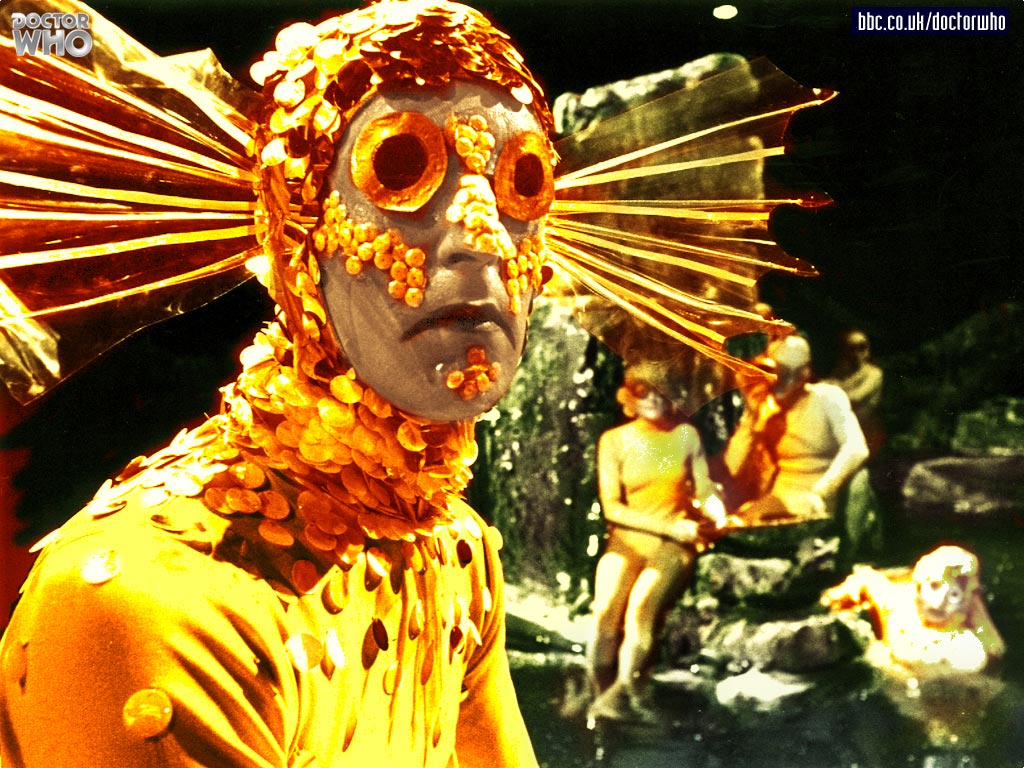
Okay, I couldn't actually find any Doctor Who monsters made out of post-it notes. I suspect
the budget didn't stretch to them. But here's a Doctor Who Fish Guy made out of sequins.

Actually, I shouldn't be joking about this stuff. Because this is us - freaky shuffling post-it note monsters, covered in a catalogue of every single way we have hurt God. And it matters to God. If God hasn't forgiven us, and thrown away all the post-it notes for us, then we will be meeting him as his enemies... and death won't be the worst thing that happens to us.

Those are our problems.
So, our first question was this: do we need a crutch?


Well, without it, every one of us will die. And every one of us will meet God as his enemy.
Yes, we need a crutch.


And we don't need some airy-fairy namby-pamby psychological crutch. All a psychological crutch will do for us is fool us into thinking we don't have a problem****.


We don't need a distraction crutch, or an analgesic crutch. We are facing real, inescapable problems, and we need a big damn solid crutch that will actually do something.


Which leads nicely into our second question: does it work? Is Christianity a real, weight-bearing crutch, that can solve the problem of death, and deal with the problem of sin? Or is it just a fake, psychological crutch used by the weak to help them ignore their impending death and feelings of guilt?

Real? Or imaginary?


Namby-Pamby Rubbish For Losers, or Genuine Solution To All Life's Problems?

And that, of course, is next week's question.


Oh, and here's Dalek-Girl. Thank you, Distraction-Crutch-Dalek-Girl.


"Exfoliate! Exfoliate!"


* I may be getting my mythologies mixed up here.
** I've not actually done this.
*** I may have done this.
****Imagine jumping out of an aeroplane, seeing the ground come closer, reaching for your parachute rip-cord and then discovering that you didn't actually bring a parachute. You brought your iPad instead, so you could play Angry Birds on the way down.